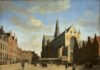
Het woord landschap betekende oorspronkelijk: geschept land. Het land dat tegen de zee wordt gegooid met een schop. Het oud Friese woord werd verbasterd in het Engels tot landskep. Nu is de betekenis van landschap niet langer zo specifiek, integendeel.
Verhoef, geboren in Friesland, toont in Les Paysages een serie recente schilderijen. In de Franse titel van de tentoonstelling weerklinkt een soort bourgeois sentiment, maar paysage behelst ook een meer politieke aanduiding van een bepaald stuk land. Een stuk land dat betekenis krijgt door een administratief kader waarmee het zich van omringende stukken land onderscheid. Paysage en schilderkunst bestaan beide bij de gratie van het kader. Het kader is het middel dat de verschillende delen van elkaar te scheidt: het landschap of het doek als partes extra partes.
Verhoef hanteert de titel Les Paysages als een schetsmatige noemer waaronder de werken gelezen kunnen worden. Een aantal werken in de tentoonstelling spelen een ondubbelzinnig spel met de geschiedenis en de conventies van de landschapsschilderkunst als genre. Andere werken kunnen opgevat worden als een soort aantekeningen in de marges buiten het kader van de paysage. Misschien kan de bezoeker met deze elementen een eigen spel spelen.
Vincent Verhoef (Nederland, 1982) is een kunstenaar en kunsthistoricus die woont en werkt in Amsterdam. Hij studeerde aan de Universiteit van Amsterdam, de Gerrit Rietveld Academie en de Jan van Eyck Academie. Verhoef’s recente werk was te zien in galerie Akinci, galerie Fons Welters, puntWG en Bradwolff Projects in Amsterdam en in galerie The Breeder en Hot Wheels Projects in Athene. Hij filmde zichzelf terwijl hij het terras van zijn huis in Athene schoonveegt en wijdde een neonlicht aan de Romeinse keizer Julianus Apostata. Hij leest nog steeds Michel Foucault omdat het einde van de moderniteit nooit helemaal lijkt te gebeuren. Sinds 2012 is hij betrokken bij artspace rongwrong in Amsterdam.
(English)
The word landscape initially meant: shoveled land. Land thrown up against the sea with a shovel. The old Frisian word was mangled into English as landskep. Now the meaning of landscape is no longer that specific, on the contrary.
In Les Paysages Verhoef, born in Friesland, shows a series of recent paintings. In the French title of the show resonates a sort of bourgeois sentiment, but paysage also implies a more political designation of a particular piece of land. A piece of land that gains meaning through the administrative frame that sets it apart from other pieces of land. Paysage and painting both exist by the grace of the frame. The frame is the agent that separates different parts from each other: the landscape or the canvas as partes extra partes.
Verhoef uses the title Les Paysages as a loose denominator that provides a possible reading for the works. Some of the works in the show play an unambiguous game with the history and the conventions of landscape painting as a genre. Other works can be perceived as a kind of notes in the margins outside the frame of the paysage. Maybe the visitor can play its own game with these elements.
Vincent Verhoef (The Netherlands, 1982) is an artist and art historian living and working in Amsterdam. He studied at the University of Amsterdam, the Gerrit Rietveld Academy and the Jan van Eyck Academy. Verhoef’s recent work has been shown at Akinci gallery, Fons Welters gallery, puntWG and Bradwolff Projects in Amsterdam and at The Breeder gallery and Hot Wheels Projects in Athens. He filmed himself sweeping the terrace of his house in Athens and dedicated a neonlight to the Roman emperor Julian the Apostate. He still reads Michel Foucault as the end of modernity never seems to fully happen. Since 2012 he is involved with artspace rongwrong in Amsterdam.
Te zien tot en met 11 april 2020.
Galerie KRUIS-WEG68
Kruisweg 68 – 2011 LE Haarlem
Telefoon: 0031 653566594
do-t/m zat. 11-18 uur en op afspraak
[su_gmap address=”Galerie KRUIS-WEG68, Kruisweg 68, 2011 LE, Haarlem”]